How Repitude decides what you lift next
Repitude is a workout log for beginners that also plans your next session. Each weight comes from the sets you logged and a fixed set of rules, and you can tap any weight to see why.
Published
Where the next weight comes from
After each set you log the weight and the reps. You can also tap how many reps you had left. From that, Repitude keeps an estimated max for each lift and works out the next weight with the same rules every time. No AI writes your plan, and the same log always gives the same answer.
Every weight is rounded to something your equipment can actually make: your plates, your dumbbells, a machine's stack, or a cable trainer's settings. It never goes below the lightest weight you own, such as the empty bar.
While you're new
Each main lift goes up a small step when you completed every rep last time. If a few reps came up short, or the last set was very hard, the weight stays the same and you try it again.
When progress slows
The lift moves to a rep range. You add reps at the same weight, and when you reach the top of the range on every set, the weight goes up a step.
Early evidence suggests adding reps before adding weight builds muscle about as well as adding weight every time. (Plotkin et al. 2022)
Reps left
The reps you had left tell the app how hard a set really was. Repitude allows for the fact that most people guess a little low, and it treats a single off day as noise, so one bad session barely moves your estimated max.
Researchers still debate how accurately people judge the reps they have left. On average they think they have fewer left than they do. (Halperin et al. 2022)
Lighter weeks and leveling off
If your estimated max or your reps dip on two or more exercises, you get a lighter week: same days and exercises, fewer sets. If one lift levels off over several weeks, the app changes something for that lift, for example a step back to build again, and tells you why.
The Why screen
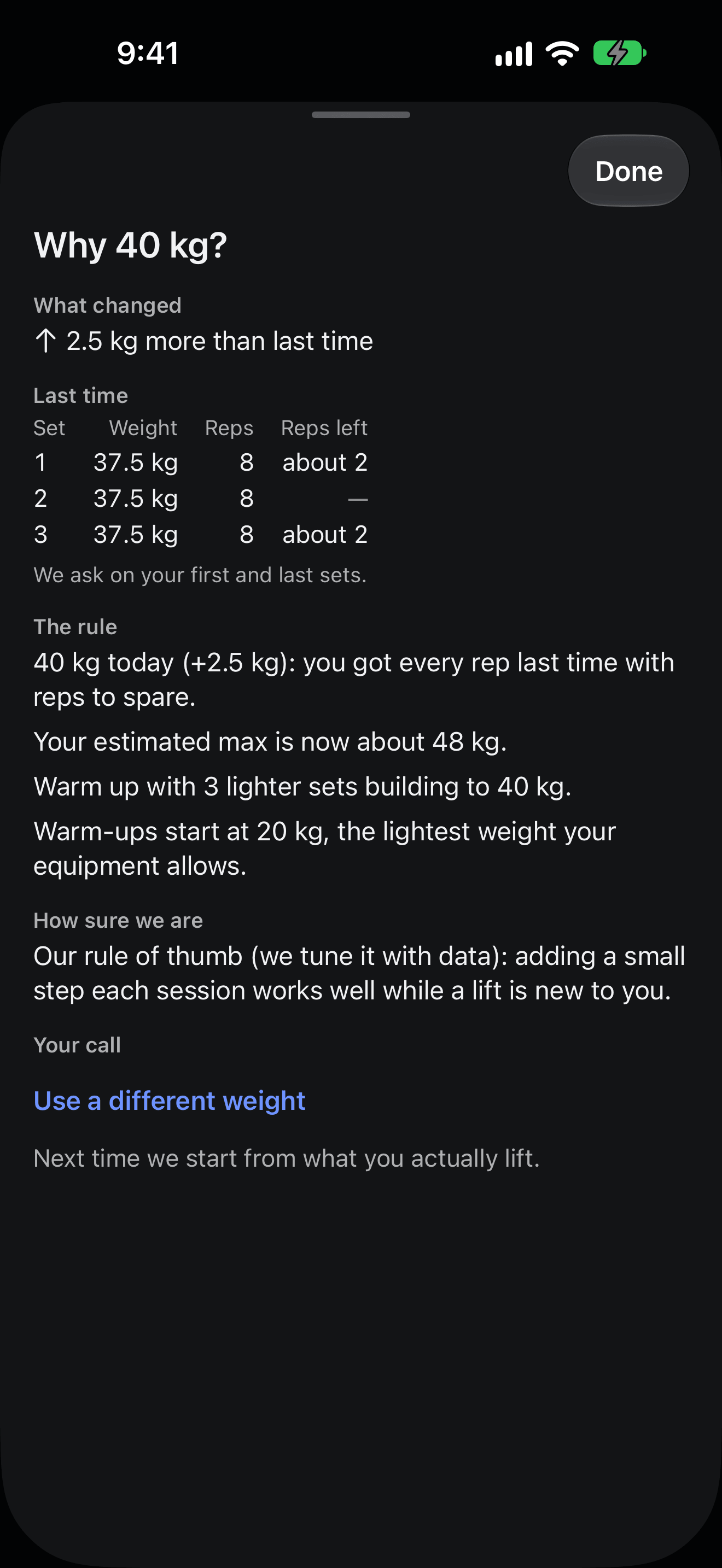
Tap Why on any weight. It shows what changed since last time, the sets it was based on, the rule in plain words, and how strong the evidence behind that rule is. When a rule is our own judgement rather than research, it says so.
Missed sessions
Your plan is a list of sessions in order, not a set of weekdays, so a missed day doesn't push anything out of place. Missed sessions aren't failures and there's nothing to make up. When you come back, the app welcomes you back without counting what you missed.
Good evidence suggests a habit takes about two months to form, often longer for exercise, and that missing a single session doesn't derail it. (Lally et al. 2010; Singh et al. 2024)
A lighter restart after a break
Each lift keeps track of how long it's been since you last did it. After a short gap, the weight stays where it was. After a longer break, that lift starts a little lighter and builds back up faster than usual until your estimated max is near its old level, then returns to your usual plan. The longer the break, the lighter the restart. The exact steps are our rule of thumb (we tune it with data).
Early evidence suggests strength lost over a break of a few weeks comes back faster than it was first built. The studies so far are small and in people new to lifting. (Ogasawara et al. 2013; Halonen et al. 2024)
Short versions
Pressed for time? Besides the full session at the length you picked, every session has a short version of about 20 minutes that keeps a few of the main lifts. It counts as a full session toward your week. Counting it in full is our rule of thumb (we tune it with data).
Progress leads with your weeks on target, not a daily streak, so a rest day never breaks anything.
Good evidence suggests that breaking a streak makes people less likely to keep going. (Silverman and Barasch 2023)
Questions
- Does Repitude use AI to write my workouts?
- No. Each weight comes from your own logged sets and a fixed set of rules, so the same log always gives the same answer. Every rule can be shown in plain words on the Why screen.
- Is it a good strength training app for beginners?
- It's built for people from their first session to a few years of lifting. In your first weeks, sets stop well short of your limit while you learn the lifts, and new lifters start with steady, simple progress.
- What if I don't log how many reps I had left?
- That's fine. If you leave it out, getting every rep counts as a success, and the plan moves on from there.
- Can I lift a different weight from the one suggested?
- Yes. Change it on the set screen. The next session starts from what you actually did, not from what was planned.
- What happens if I miss a session or a whole week?
- Nothing to make up. Missed sessions aren't counted as failures, and your next session is simply the next one in your plan. If you were away long enough for it to matter, that lift starts a little lighter and builds back up.
- How long is the short version of a session?
- About 20 minutes, and it counts as a full session toward your week.
Sources
Each source says how strong its evidence is. On this page, "Research consistently shows" means strong evidence, "Good evidence suggests" means moderate, and "Early evidence suggests" means limited. Guidelines written by expert panels are marked as expert consensus. Where a rule is our own rule of thumb, the page says so.
- Plotkin et al. 2022. Progressive overload without progressing load?. Evidence: limited (one trial).
- Halperin et al. 2022. Accuracy in predicting repetitions to task failure in resistance exercise. Evidence: debated (studies disagree on how accurate people are).
- Lally et al. 2010. How are habits formed: modelling habit formation in the real world. Evidence: moderate.
- Singh et al. 2024. Time to form a habit: a systematic review and meta-analysis. Evidence: moderate (review of a small, mixed-quality set of studies).
- Silverman and Barasch 2023. On or off track: how (broken) streaks affect consumer decisions. Evidence: moderate.
- Ogasawara et al. 2013. Comparison of muscle hypertrophy following 6-month of continuous and periodic strength training. Evidence: limited (small study, people new to lifting).
- Halonen et al. 2024. Does taking a break matter: adaptations in muscle strength and size between continuous and periodic resistance training. Evidence: limited (small study, people new to lifting).
Try Repitude
Repitude is free for iPhone and Apple Watch, with no account needed to train. Join the waitlist to hear when it's ready.
For iPhone and Apple Watch. iOS 26 or later. Apple Watch app needs watchOS 26 or later.